consciousness

How To Complain

Have you ever let go of a persistent unhelpful pattern of thought?  As I’ve attempted to let go of automatic thought patterns I’ve noticed that my mind has no shortage of other patterns that work just as efficiently as fuel for thought.

One of the easiest thought patterns to get trapped in is complaining.  Complaining can be effortless, especially when it involves a situation where a correction really needs to be made.  But situations can be righted in ways that don’t create personal blame, negative energy, and food for more autopilot thinking.  A helpful question to ask before complaining about a situation is, “Am I taking this personally?”  Right away a space is created between your reaction and your conscious self.

I’ve been too excited about the rebroadcast of Oprah and Tolle’s A New Earth web-series, and I love the following video because it so clearly lays out the two ways to complain, their consequences, and how to end up with your desired outcome.

Standard
Ego

“How To Cure An Addiction To Drama”

Does drama seem to follow you wherever you go?  Do you just want a moment of peace, but find that it is ever elusive?  In my own life I can see moments where unhappiness and drama reigned supreme, and while I genuinely wanted peace, the ego within me lived for and on those dramatic moments.

When situations seem out of control, and your reactions seem like the only appropriate responses to such craziness, take a step back and witness your sense of self becoming all wrapped up in those outer situations.  Feel the need to react, and watch the tirade of thoughts that follow. This creates a small space that is enough room for your true self that only wants peace to shine through and provide clarity and equanimity.

I’m so excited that OWN is re-broadcasting the webcast of Oprah and Eckhart Tolle’s chapter by chapter discussion of A New Earth.  One of the great gems of wisdom from these discussions is this clarifying piece on how to cure an addiction to drama.  If you witness yourself complaining, blaming, or discussing the shortcomings of others, (and really who doesn’t), this video is a breath of fresh air:


Standard
You

How To Be Alone

By Eckhart TolleThe following video is not just beautiful and inspirational.  It also speaks to the heart of the human experience and the lesson we must all learn at some point in our lives, at the latest when we are about to transition from this world.  That lesson is how to be alone.  Whether you are physically alone now or not, you are the only constant in the equation of your life, all other variables change.  Now is the time to discover that constant self, and now is in fact the only place where who you are can be found.

Standard
Inspiration

What To Do When You Don’t Know What To Do

PHOTO BY PETER SPEROAs the years pass what I want to be has become clearer to me.  I want to be consciousness, love, peace, joy, and utterly present.  What continues to elude me is what I want to do.  Not knowing my outer purpose has caused me to engage in a lot of efforting to “figure it out,” which comes along with the residual anxiety from thinking I should know what I want to do when I don’t yet know.  This mental non-acceptance of what is, not only causes suffering, but is also a sure ticket to becoming out of alignment with the present moment.

The other night I received a profound message from a colleague who wasn’t even trying to offer advice.  She told me that all through her twenties she kept trying to do what she thought she was supposed to do; she tried to “make it happen.”  But eventually everything came together, her outer purpose became clear as day and was not what she initially worked for all those years.  For her, this new understanding would have come one way or another, and the years spent thinking she was supposed to have it all figured out would have been much better spent just enjoying herself.  Not only would her purpose have presented itself eventually anyway, she said it probably would have become apparent much sooner had she not been attempting to “make it happen” the way she thought it was supposed to.

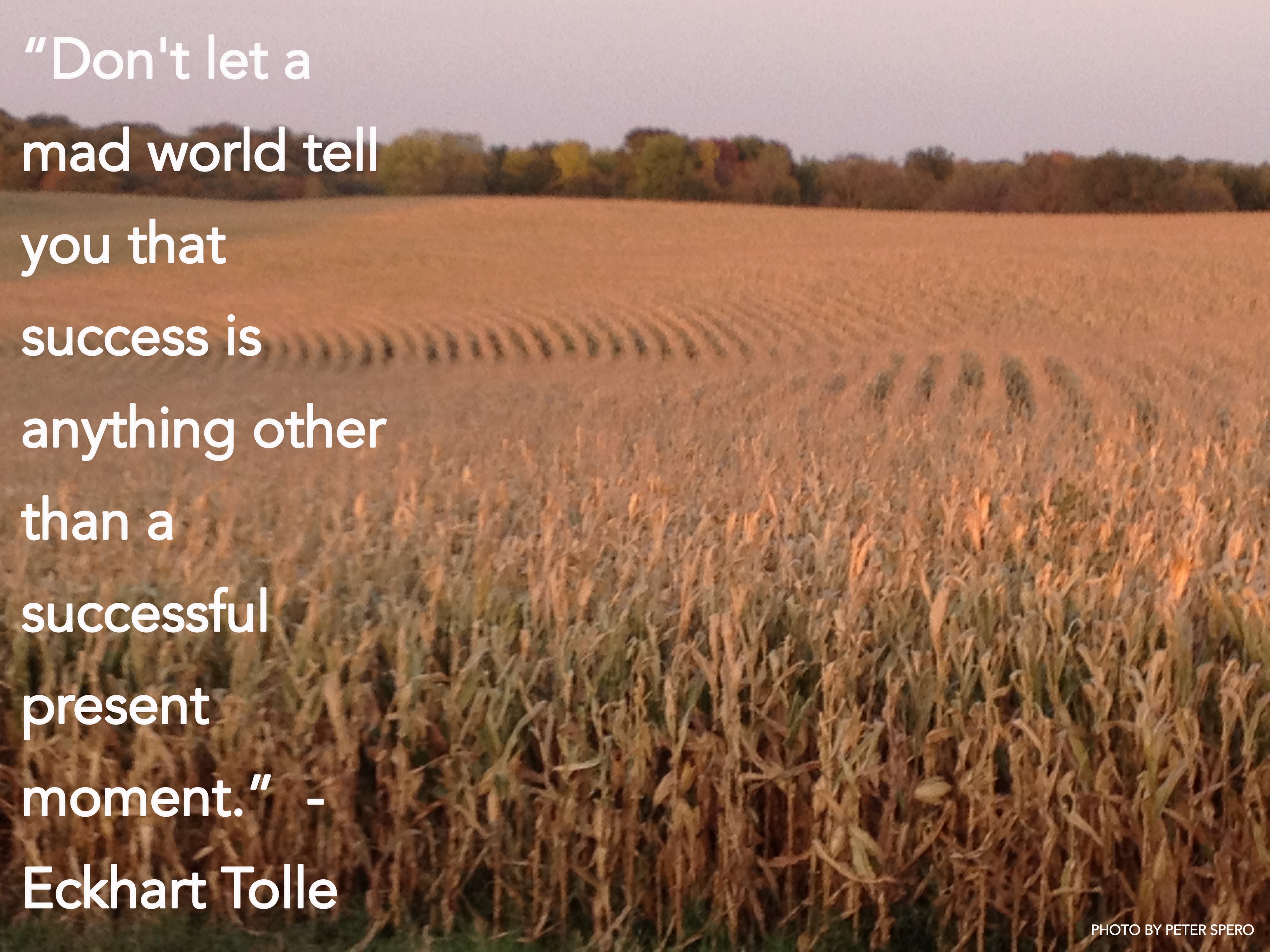
In the gift of her story I heard echoes of Tolle, “Don’t let a mad world tell you that success is anything other than a successful present moment.”  Enjoy the “right now”, no matter how messy that “right now” appears, and how elusive future security may seem to the thinking mind. A seed of joy now will be realized in even greater abundance in the future.  A seed of presence now, will grow into your life’s outer purpose.

Standard
Life

The Good In The Extreme

High and LowExperiencing extremely high highs in life, along with very low lows, is exhausting.  There are some who enjoy that way of living, and there are also many wisdom teachings detailing how to escape such a precarious existence.  But just as in meditation, where you constantly are bringing your attention back from a wild train of thought to the present moment, experiencing going from very unconscious states to extremely aware states of being within the span of a day, an hour, or a minute is essential in the practice of living.

Some days I experience extreme fear, worry, and distress.  It can happen, when overcome with negative emotions or powerful thought patters, that I will bring a little bit of present moment awareness into my field of attention and take a step away from the crazy.  This type of experience is helpful in building up what Tolle calls “presence power,” that when accessed more and more easily, will eventually kick in before the thought patterns and emotions have a chance to take over.  But it is okay to go even further than a small glimpse of awareness.

I am now experiencing that when I fall into unconscious suffering, and bring that spark of present moment awareness into the situation, that I don’t need to stop there.  I can remind myself of the true depths of joy and peace available in the present moment, remember all that I have learned in the power of the reality of the here and now.  Not only can I shed light on the dysfunction that had caused fear to become all important in my field of attention, I can dissipate that fear with radical acceptance, and allow myself to feel peace, allow a smile, allow joy in the midst of anxious thought patterns.

This “allowing” is not passive.  It takes the same power required when the energy of residual pain makes peace and happiness seem like the last thing in the world you’d want to feel, but you “allow” yourself to disidentify from that loud voice of pain and smile anyway.

Extreme happiness and extreme sadness lead to a weary existence.  But moments of extreme unconsciousness that transform into moments of all encompassing present moment awareness can lead to the empowerment of your ability to dissipate the pain created by identification with the thoughts and emotions.  Judging a moment of pain, fear, or sorrow will lead to more of the like, but accepting it and entering fully into the present moment strengthens the light of your consciousness that can dissolve the deepest darkness.

Standard
Ego

The Easiest Way To Get Rid Of The Ego

Mimi and KatieHow can you become aware of the ego in you?  The ego is the sense of self that is created when your identity becomes all wrapped up in form: thought forms, what you have/don’t have, the state of the body, situations.  And while an identity based on that which will inevitably change leads to suffering, the good news is that becoming aware of the ego is the easiest way to go beyond it and discover your true self.

Any moment when you watch your thoughts without judgment provides just such an opportunity.  But for me, the ego becomes extremely obvious when I am criticized.

As a child the slightest hint of disapproval from another would reduce me to tears.  By the time I was a teenager I was fed up with this reaction that I felt powerless to control.  The suffering created by the disapproval of others was so obviously disproportionate to the experiences themselves that the dysfunction was easily recognizable.  

What I didn’t understand at the time was that my identity was wrapped up in form, mainly in the thought forms, opinions, I perceived others held of me.  When this ego identity was diminished by criticism the ego promptly rebuilt itself through my identification with the reaction to this diminishment, negative emotions and unhappy thoughts about myself and my situation.  My ego also easily remained in place through identification with negative thoughts about the person who had first diminished it.

When someone criticizes or offends you, watch your mind. It will come up with thought after thought until you either find one to identify with, or until it quiets down from the lack of momentum created by your conscious presence.

One of Eckhart Tolle’s most helpful exercises is to occasionally allow the diminishment of your ego.  When someone criticizes you, don’t immediately retaliate or condemn the other person.  Allow the ego to die a little bit.  (Just be careful that the ego doesn’t sneak back in through identification with the mental position of the other person or a negative self-image.)  It feels uncomfortable at first, but gives way to a peace that makes that moment of tension seem wholly insignificant.

Standard
Inspiration

“Suffering is necessary until you realize it is unnecessary.” – Tolle

Good Morning Today I slept extremely late. Having a day free from work and obligations is a beautiful thing and I usually relish it.  But today, instead of enjoying the time off, I decided to make a big “to-do” list to keep unsettlingly at the forefront of my mind, while feeling completely unmotivated to accomplish any of my tasks.  I kept wishing I had the motivation to get things done while I actually had the spare time.  At the same time I felt nervous knowing that if I didn’t complete my “to-do” list today, I would be in a panic later on when I would be busier.

Does this sound at all familiar? Have you ever woken up in a funk?  Have you ever wished you could just feel better or feel more motivated?

This morning, in my day-off funk, I decided the least I could do was watch some videos on YouTube in the hopes that something inspirational would pop up.  If you’ve ever watched an Eckhart Tolle video, and if you read this blog regularly you most certainly have, you will know that each video starts with the sound of a bell, a high-pitched “ping,” which is coincidentally now the iPhone alert for a text message.

The second I heard the “ping” I realized what I had been doing all morning.  I was hoping that at some point the feeling of motivation would overtake me, and I’d get up and take action.  I was waiting for this feeling to happen.  But feelings don’t just fly through the ether and enter in through your ears.  They are created and experienced from within your very self.

All morning I was waiting for an emotion to happen to me, when the only way to feel that emotion was to create it myself.  Waiting to feel motivated is a trick.  It won’t happen.  You have to make the decision to invite that feeling forth within yourself.  The good news is that this is not as big of a task as it may seem.

Feeling the way you want to feel only takes one small step in this one moment you are experiencing.  That small step may be washing your face and brushing your hair, or going to a cafe to get some tea or coffee, or searching YouTube for an inspirational video.

With that being said, I now relinquish my big “to-do” list, and am finding my motivation right here with this one task of typing words on a keyboard.  The next step will take care of itself; the next task will happen in the moment that it happens.  Until then, I will work on creating the way I want to feel in each small act.

Understanding that emotions are created within, and choosing which emotions you want to feel, are the first steps to getting out of a funk.  I invite you to make that choice with me.  What inner feeling do you want to cultivate today?
Standard
Inspiration

Eckhart Tolle’s “Secret Formula”

Photo by Peter SperoEckhart Tolle has a “secret formula” for navigating the myriad of changing forms we call life.  I’m going to give it away, even before the video: what is is.  Ok so the formula is no secret, it is pretty obvious that this moment is how it is.  Such a perspective could not be more basic.  But when you actually feel that “what is is” a momentous transformation takes place.  You have allowed your experience to be as it is, and in surrender have placed yourself at the seat of power. You can now witness your situation and allow the highest potential response to emerge from that awareness.  Burden and effort are replaced by ease, spontaneity, and creativity.  In the following video Tolle offers how to enter this state in any given situation:

https://www.youtube.com/watch?v=RFhCi0ygOhU

Standard
spirituality

The Meaning of Spirituality

IMG_0621

When studying poetry in college I often heard, and posed, the question, “what does this mean?”  

One of the more commonly frustrating aspects of poetry is that, as a reader, it is natural to want to know the meaning of a poem when the meaning can be fluid and not obvious.  This begs the question, what is the meaning of poetry altogether?

It was only through the act of writing poetry that I began to truly understand the answer to that question.  More intelligent and creative poets are able to articulate their answers exquisitely, and while I cannot yet satisfactorily answer that question through prose I nonetheless have the understanding, the essential first illuminating step that precedes a verbal explanation.

What does this have to do with spirituality?  Like poetry, spirituality can seem elusive, vague, and unsatisfyingly fluid in its meaning.  But just as the act of writing a poem can help a person understand the meaning of poetry better than any cerebral exercise, the practice of spirituality is the basis for gaining a real understanding of the meaning of that word.  In the following video Eckhart Tolle beautifully articulates where the true meaning of spirituality can be found:

https://www.youtube.com/watch?v=KWJsphnmGXE

Standard
consciousness

Spilled milk: to cry or not to cry?

PHOTO BY PETER SPERO

Today I almost cried over spilled milk, literally.  I splurged on fancy organic milk and as I was walking through the door to my home it fell to the ground, broke open, and spilled everywhere. It wasn’t just a trivial problem, it was the trivial problem.  Yet, that didn’t matter to my thoughts which easily picked up on why this was an issue I should be upset about. When I am easily upset by small things it is a reminder that I’ve forgotten who I truly am, my infinite true self.  

When I try to remember the problems I had a year ago today, or even last Sunday, I have no inkling of what they were.  Can you remember what problems you had last year?  Can you remember the problems you had five years ago, or ten? The only problems I think about are those I am experiencing now, which will soon fade with the passage of days and be replaced with new issues to be bothered about.  The situations themselves are not problems, they are how they are.

Problems are created by thoughts about a situation.  Suffering, and negative emotions, are created by judgement of an experience.

It is easy to see how spilled milk is only a problem when I make it so through my thoughts.  It can be more difficult to watch experiences without judgment when the stakes are high.  I am grateful for this passage from Swami Satchidananda’s Weekly Words of Wisdom, because it is a great reminder to stop grasping at outer solutions for peace and happiness and remember who we really are:

“The teaching in the Bible, just as we find in the Bhagavad Gita is: Don’t look for the fruits of your own actions. You are made in God’s own image. You don’t need to look for fruits from outside. But Adam forgot that he was God’s image. And forgetting is what you call avidya, or ignorance. You forgot your truth. The minute you forget it then you look for it from outside. So Adam thought, ‘Ah, by eating the apple I’ll be happy.’ That was said to be the first ‘sin.’ Eating the apple was not the first sin. Forgetting his true nature was the original sin. Once you forget your true nature, you will commit face many, many problems. So, remember who you are.” (Swami Satchidananda)

Standard