Peace

How To Know When You Can Finally Be At Peace

At The Airport What were you worried about yesterday? What about last month or last year?

As I woke up today with tingly feet and immediately began worrying about my them, I remembered that the day before I worried about a one-day teaching residency I’m going to have to travel extremely far for, to a part of Chicago that is as of yet completely unknown to me.   When I decided to allow the discomfort in my feet, and surrender to the present moment, my mind started thinking about finding a new apartment in September and how stressful that might be.

Sound familiar? When life is stressful the voice in the head tells us that after a certain point or after something happens we will finally be at peace.

Even though I think that I’ll be at peace after I figure out what is going on with my tingly feet, when that moment does come my mind will just as soon have an exorbitant amount of other things I’ll have to wait for until I can be at peace.

While the content of the thoughts we have differs, we all experience the same mechanics.  There is always a phantom future moment when the mind will agree to let you relax and enjoy life.  And that is exactly how that voice stays alive, in control of your attention.

Once I was able to become aware that unless I decided to be at peace now I’d never actually be at peace, I was able to choose peace now despite the circumstances.  The long standing thought mechanics in my mind still had a whole lifetime’s worth of energy to keep it going, so the worry thoughts popped up nevertheless.

Despite this mind mechanic momentum, to smile and allow yourself to relax even when your thoughts are still vying for your attention, is to take control of your life and your sanity.  In that moment you are present and the momentum gained from that glimpse of consciousness will only grow. Eventually the old thought mechanics will lose steam and peace will be all the remains inside and out.

Standard
Life

The Good In The Extreme

High and LowExperiencing extremely high highs in life, along with very low lows, is exhausting.  There are some who enjoy that way of living, and there are also many wisdom teachings detailing how to escape such a precarious existence.  But just as in meditation, where you constantly are bringing your attention back from a wild train of thought to the present moment, experiencing going from very unconscious states to extremely aware states of being within the span of a day, an hour, or a minute is essential in the practice of living.

Some days I experience extreme fear, worry, and distress.  It can happen, when overcome with negative emotions or powerful thought patters, that I will bring a little bit of present moment awareness into my field of attention and take a step away from the crazy.  This type of experience is helpful in building up what Tolle calls “presence power,” that when accessed more and more easily, will eventually kick in before the thought patterns and emotions have a chance to take over.  But it is okay to go even further than a small glimpse of awareness.

I am now experiencing that when I fall into unconscious suffering, and bring that spark of present moment awareness into the situation, that I don’t need to stop there.  I can remind myself of the true depths of joy and peace available in the present moment, remember all that I have learned in the power of the reality of the here and now.  Not only can I shed light on the dysfunction that had caused fear to become all important in my field of attention, I can dissipate that fear with radical acceptance, and allow myself to feel peace, allow a smile, allow joy in the midst of anxious thought patterns.

This “allowing” is not passive.  It takes the same power required when the energy of residual pain makes peace and happiness seem like the last thing in the world you’d want to feel, but you “allow” yourself to disidentify from that loud voice of pain and smile anyway.

Extreme happiness and extreme sadness lead to a weary existence.  But moments of extreme unconsciousness that transform into moments of all encompassing present moment awareness can lead to the empowerment of your ability to dissipate the pain created by identification with the thoughts and emotions.  Judging a moment of pain, fear, or sorrow will lead to more of the like, but accepting it and entering fully into the present moment strengthens the light of your consciousness that can dissolve the deepest darkness.

Standard
Ego

The Easiest Way To Get Rid Of The Ego

Mimi and KatieHow can you become aware of the ego in you?  The ego is the sense of self that is created when your identity becomes all wrapped up in form: thought forms, what you have/don’t have, the state of the body, situations.  And while an identity based on that which will inevitably change leads to suffering, the good news is that becoming aware of the ego is the easiest way to go beyond it and discover your true self.

Any moment when you watch your thoughts without judgment provides just such an opportunity.  But for me, the ego becomes extremely obvious when I am criticized.

As a child the slightest hint of disapproval from another would reduce me to tears.  By the time I was a teenager I was fed up with this reaction that I felt powerless to control.  The suffering created by the disapproval of others was so obviously disproportionate to the experiences themselves that the dysfunction was easily recognizable.  

What I didn’t understand at the time was that my identity was wrapped up in form, mainly in the thought forms, opinions, I perceived others held of me.  When this ego identity was diminished by criticism the ego promptly rebuilt itself through my identification with the reaction to this diminishment, negative emotions and unhappy thoughts about myself and my situation.  My ego also easily remained in place through identification with negative thoughts about the person who had first diminished it.

When someone criticizes or offends you, watch your mind. It will come up with thought after thought until you either find one to identify with, or until it quiets down from the lack of momentum created by your conscious presence.

One of Eckhart Tolle’s most helpful exercises is to occasionally allow the diminishment of your ego.  When someone criticizes you, don’t immediately retaliate or condemn the other person.  Allow the ego to die a little bit.  (Just be careful that the ego doesn’t sneak back in through identification with the mental position of the other person or a negative self-image.)  It feels uncomfortable at first, but gives way to a peace that makes that moment of tension seem wholly insignificant.

Standard
Ego

The Problem With Being Right

Dr. Wayne DyerHave you ever been in a situation where you were absolutely in the right, but were unable to convince someone else who had a differing viewpoint?  When you are right, and someone else is wrong, especially about basic facts (e.g. when water is frozen it becomes ice), it can be frustrating to say the least.

When I’m in the middle of an argument I can feel the infuriation rise the more I try to convince the other person of my side.  The other day when I was attempting to explain how to read a piece of sheet music to my friend, who disagreed with my interpretation, it became clear to me that the more I tried to convince him of my understanding, the more frustrated I became.  In the midst of the argument I asked myself, “why?”  When it isn’t a matter of life or death, is convincing another of your “rightness” really worth it?

The need to be right, even when you are, can erode relationships and prevent us from seeing each other as the complex, mysterious human beings we truly are.  The need to be right is also the perfect doorway for the ego to take over your life.  Identifying with a mental position and fighting for the life of that position is ego.

Next time an argument starts to go off the rails, take back control from the ego by letting go of the need to convince another person of your position.  But be careful that the ego doesn’t sneak back in through judgment of the other person based upon their thoughts.  When I let go of a mental position and feel satisfied because I am the “bigger person” I have let the ego take control in the most opportune moment for its demise.  On the other side of identification with thought is true communication, greater understanding, and better relationships.

Standard
consciousness

This Includes You

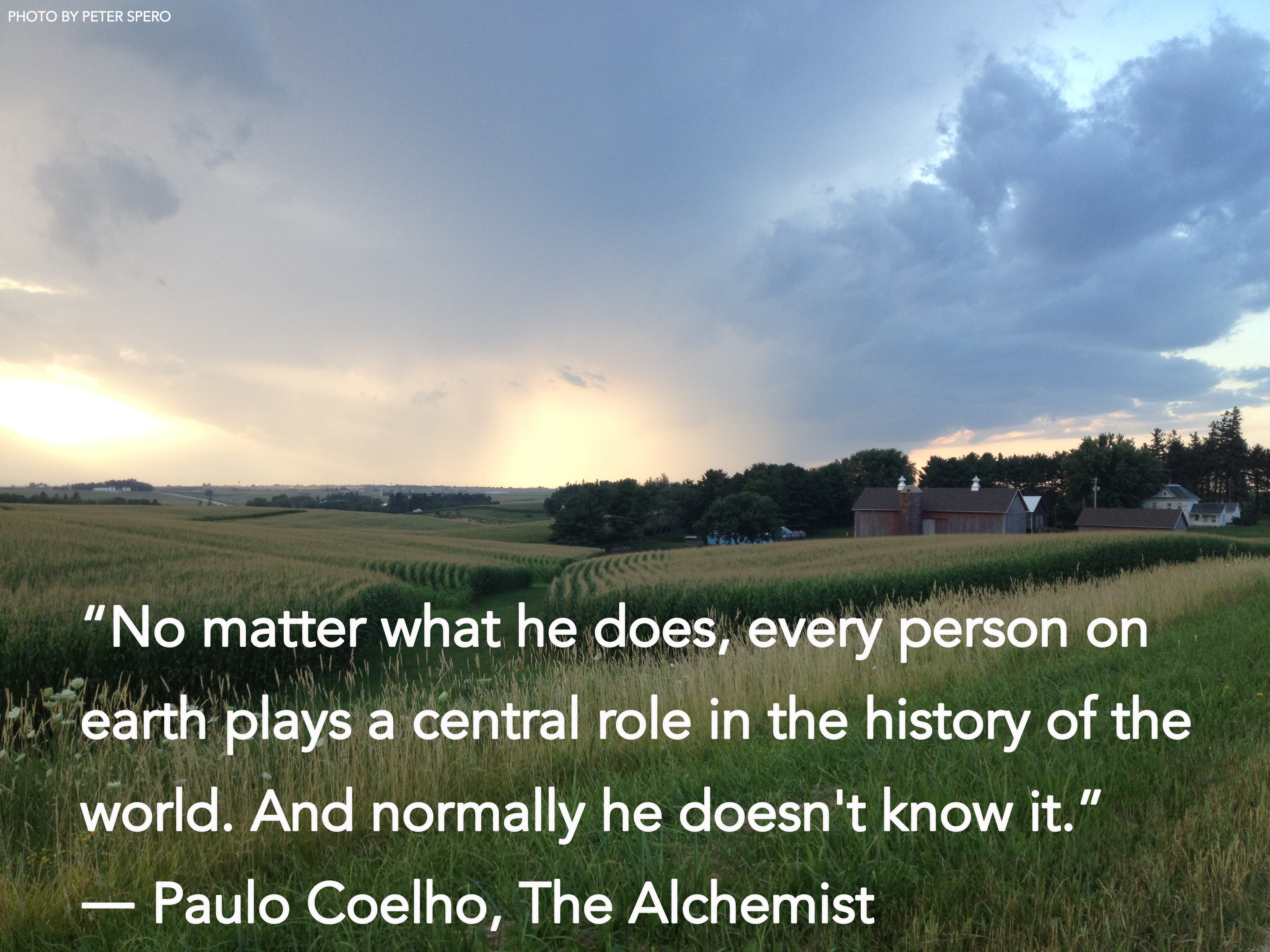
PHOTO BY PETER SPERO

While I never read Paulo Coelho’s The Alchemist in high school, on a whim I began listening to the audiobook version this morning as I went through my daily routines.  I could barely bring myself to stop listening when I arrived at work. 

The narrative is thrilling, but the wonderment of Coelho’s tale is in its bare, purposeful wisdom regarding the nature of existence.

The quote in the picture above is not merely a kind sentiment, meant to bolster self-confidence.  It is a universal principle operating inexorably through all of us, through all of life.  When you live with the felt and realized understanding of your true worth and role in creation, you not only take responsibility for the power of your life, but you also align yourself with your purpose for being.

Standard
consciousness

Step 1 To Positive Change

Photo by Peter SperoWhen there is something you want to change about your life there is one vital first step. Whether it be a situation, a relationship, a feeling, or a lifestyle that needs to change, the necessary first step is always the same.


What is this important precursor to positive change? Simply put: acceptance.

Before change, before action, before decisions, accept what is. Your mind won’t want you to, because non-acceptance is its lifeblood.  But here is what the ever-present stream of thinking doesn’t know: when you are at peace with what is, whatever follows will be in alignment with that peace and create more of the like.

Standard
You

Love Letters

Could you write yourself a love letter?  Reading a letter from someone else expressing love to you is a wonderful experience, but there is nothing quite like being wholly accepted, acknowledged, and loved by yourself.  Being a good friend starts at home; acting and speaking like a good friend to yourself is great practice at how to be a good friend to others.  As cheesy as the premise of the following SoulPancake video may seem, I love the idea of writing a love letter to your very own self.  An awesome byproduct of hearing these people’s love letters to themselves was that I ended up loving them too.

Standard
consciousness

How To Make Stress Good For You

Gene's Grocery If you were absolutely sure, beyond any doubt, that your thoughts create your experience of reality, what you would you do?  Or rather, what would you think?

The following video offers amazing examples of the power of belief over our ability to maintain a state of health and well-being.  But it goes further than that.  It tells us that stress, which is commonly linked to negative physical side effects, is made negative by our thoughts about it.

Psychologist Kelly McGonigal cites a study done in the US that tracked 30,000 adults for eight years.  At the beginning of the study those adults were asked about their levels of stress in the last year and if they believed stress was harmful for their health. Then, as McGonigal states, “they used public death records to find out who died.” While people who experienced a high level of stress had a 43% increase in dying, they all had one other factor in common, they believed stress was bad for them.  The adults who were highly stressed but didn’t believe stress was harmful to their health had the lowest risk of dying of anyone in the study, including the participants with relatively low levels of stress.

McGonigal goes on to explain these results on a physical level, but the message of her TED talk has implications for more than just the experience of stress.  When we experience anything in our lives we have the choice to accept that it is happening, or resist it internally.  Nonresistance of what is not only opens us up to experiencing the highest manifestation that can be born of that situation, but it also allows the body to regulate itself and maintain its own health.

Today I invite you to ask yourself, “What thoughts about my life situation are causing me pain or dis-ease?”  Experiment with replacing that view-point with one that is accepting, empowering, and joyful.  You could be saving your own life!

Standard
spirituality

The Meaning of Spirituality

IMG_0621

When studying poetry in college I often heard, and posed, the question, “what does this mean?”  

One of the more commonly frustrating aspects of poetry is that, as a reader, it is natural to want to know the meaning of a poem when the meaning can be fluid and not obvious.  This begs the question, what is the meaning of poetry altogether?

It was only through the act of writing poetry that I began to truly understand the answer to that question.  More intelligent and creative poets are able to articulate their answers exquisitely, and while I cannot yet satisfactorily answer that question through prose I nonetheless have the understanding, the essential first illuminating step that precedes a verbal explanation.

What does this have to do with spirituality?  Like poetry, spirituality can seem elusive, vague, and unsatisfyingly fluid in its meaning.  But just as the act of writing a poem can help a person understand the meaning of poetry better than any cerebral exercise, the practice of spirituality is the basis for gaining a real understanding of the meaning of that word.  In the following video Eckhart Tolle beautifully articulates where the true meaning of spirituality can be found:

Standard