Life

Decisions: How do you know if you’re right or wrong?

Goodbye Playhouse!

Do you trust in your own decision-making abilities?  How do you know if you’ve made the choice that will lead to the highest potential outcome?  How can you maintain trust when people and situations reveal themselves to be different than you initially believed?

This coming week my grant-based job of four years is coming to an end and life is thrusting me into change and uncertainty.  In work, as well as in relationships, my mind’s favorite candy is questioning my ability to make decisions that are in my best interest.  The voice in my head could live an entire life surviving purely on self-doubt.

When I have difficulty trusting in people or situations I remind myself that I don’t have to trust in any thing, I only have trust in the universe, God, life itself.  Yet, sometimes the voice in my head has enough momentum that even this perspective fails to interrupt its destructive thought pattern. This is why I am so grateful for the insight in the following video.  It reminds me of what it feels like when my decisions are being guided by the clear perspective of present moment awareness, rather than the clever arguments of the mind.  Being able to discern between the two is the difference between peace and suffering.

Standard
consciousness

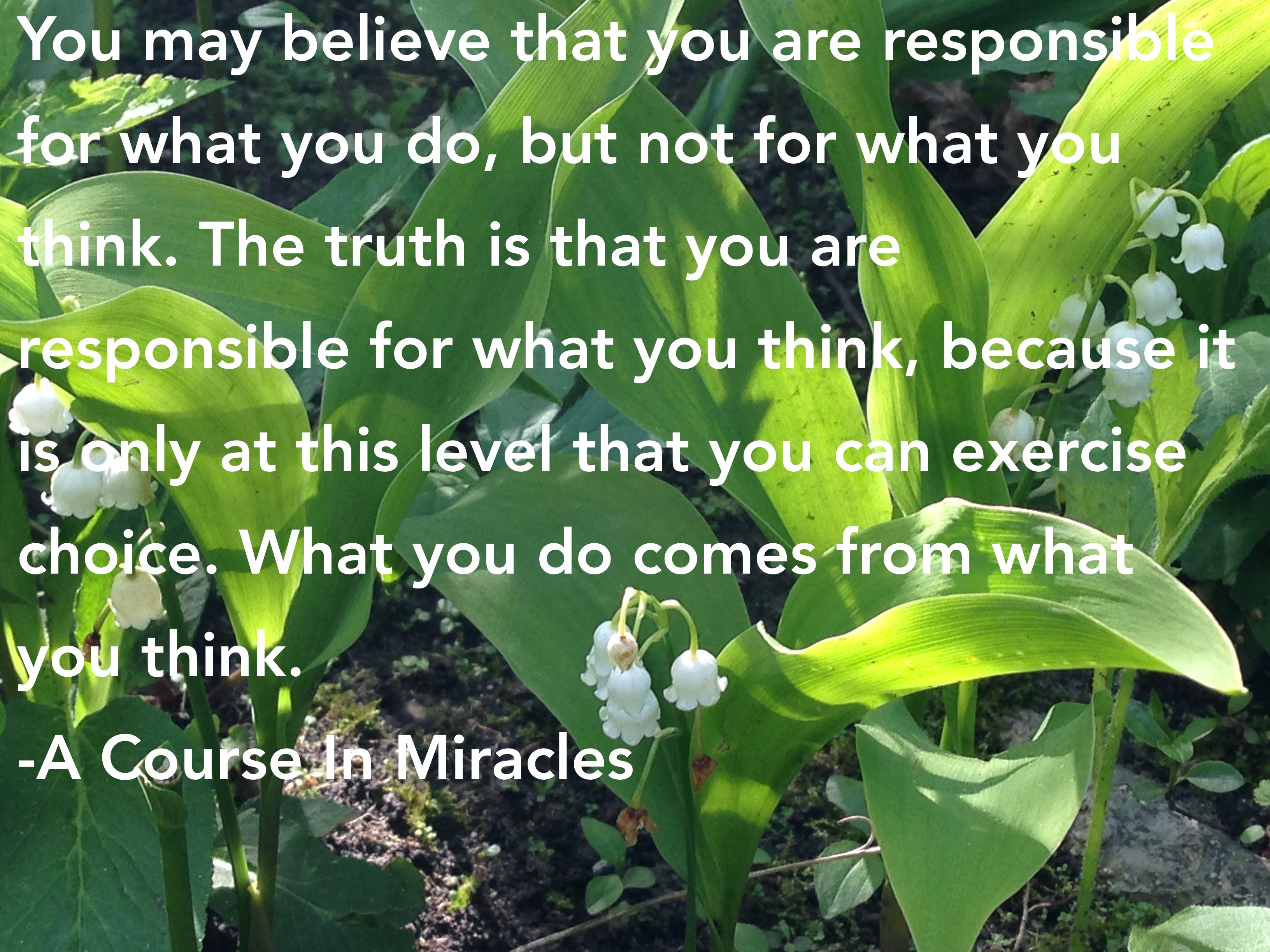
Thinking vs. Doing: What are you responsible for?

ACIM

We all have a perfect view for the bizarre parade of our own thoughts.  As this both random and repetitive display barrels ever on, we are constantly presented with a choice.  We can sit back in the lounge chair of our consciousness and witness this interesting spectacle as it passes, or we can pick out whatever catches the eye and hold onto it, even follow it off in its own direction.  Whether or not your thoughts are pleasing and true depends on which particular section of the parade is passing you by, but no matter what kind of thoughts you have, you can always decide which ones to believe.

Standard
Peace

How To Deal With Other People

HopeWhat can you accept in other human beings?  If we look within, most of us will find that there is a certain level of “otherness” we are able to accept, beyond which tolerance dissolves.

This is more obviously the case when we examine our feelings towards people who are dangerous, break laws, or don’t adhere to societal norms of behavior.  On a more subtle level, I see it on the CTA during Chicago’s morning commute, when two people have a loud conversation instead of scrolling through their iPhones.   In that moment a humorously clear gulf is created between the quiet majority, and the atypical loud morning conversationalists.

What creates this separation between people?  It is born of thoughts and opinions in the mind that are completely bought into.  Luckily this can be overcome more easily than it would appear, even in the face of humanity’s long history of alienating others who seem too different to allow.

When you are able to observe these thoughts as they happen, you haven’t immediately identified with them and taken them as truth.  When you see thoughts of separation in the mind, that witnessing provides the choice between alienation and inclusion.  It provides the opportunity to not accept judgment of others as absolute truth.  Before peace becomes more noticeable on a societal level, this small decision will be building its firm foundation.

Standard
Life

Mother: Role or Real?

Sally and KatieWe all play roles. Sometimes we are a doctor or patient, a waiter or customer, a spouse or coworker. All of these functions turn into roles when your sense of self gets wrapped up in what you do.

All role-playing is transcended when we are present, responding to the needs of the moment we experience instead of acting out our mind’s idea of what our role entails. The same can be said for mothers. Being a mother can turn into a role when it is a mental concept. But one of the amazing things I’ve observed from mothers is the complete transcendence of roles.

I’ve observed my mother and grandmother, my aunts and friends who are mothers, being constantly present, responding purely to what is required in each moment. They go beyond the role of mother, and reveal where that role originated. They are creators, sustainers, love bearers, teachers, healers, unifiers, transformers. They are alchemists transforming love into life. Mothers bear the burdens of nations and create vital changes in the world that are necessary but often not invited. They act from love even when repaid in hatred or apathy. Thank you mothers for transcending roles, and birthing a better world generation after generation.

My own mother not only gave me the gift of life, but also taught me how to live. She provided a space to grow as a human being, free from judgment, in the all-encompassing embrace of unconditional love. It is with the love I have learned, and continue to learn, from my mother that I offer this gift of relaxation. Take a moment and be refreshed with Let Yourself Learn’s deep relaxation, based on Shavasana from Integral Hatha Yoga and the wisdom teachings of Swami Satchidananda.

Click here for a free download of the audio version of Shavasana with Katie Spero.

Standard
consciousness

How To Complain

Have you ever let go of a persistent unhelpful pattern of thought?  As I’ve attempted to let go of automatic thought patterns I’ve noticed that my mind has no shortage of other patterns that work just as efficiently as fuel for thought.

One of the easiest thought patterns to get trapped in is complaining.  Complaining can be effortless, especially when it involves a situation where a correction really needs to be made.  But situations can be righted in ways that don’t create personal blame, negative energy, and food for more autopilot thinking.  A helpful question to ask before complaining about a situation is, “Am I taking this personally?”  Right away a space is created between your reaction and your conscious self.

I’ve been too excited about the rebroadcast of Oprah and Tolle’s A New Earth web-series, and I love the following video because it so clearly lays out the two ways to complain, their consequences, and how to end up with your desired outcome.

Standard
consciousness

The Pros and Cons of Mind Reading

Thinking MindHave you ever wished you could read minds?  It seems like an incredible super power. There are some obvious perks: you’d do very well on game shows that ask trivia questions, and you’d know what the silent teenager across from you at the dinner table was actually thinking.  But the gilded idea of mind reading would very quickly become exposed as a major disappointment.

Our minds operate according to the same structure, with different content for each person.  The mind uses the content of your life to fuel its never-ending cycle of thought after thought. It also efficiently uses those thoughts to build up momentum for its continued operation.

Even though it seems logical to base your thoughts about another person on the thoughts they have or share with you, in reality they are a human being who also happens to contain the same thought-creating machine you do, and more often than not that machine is running on autopilot.  Mind reading would only end up telling you what content that person’s mind uses to fuel its incessant thinking, and not who that person truly is.

Can you tell which thoughts you consciously choose to entertain versus those that randomly fire of their own accord?

If I am honest and aware, I can tell that the majority of my thoughts are produced by a mind on autopilot with no actual prompting decision to engage in thinking.   I don’t consider this a failure, rather it is liberating!

When you can watch your thoughts and notice which ones were on purpose, and which ones were involuntary, you can choose to not take the autopilot thinking too seriously. The more you notice involuntary thinking, the more you are able to choose thoughts that are of some purpose for you instead.  Thoughts of worry, fear, judgment, complaints, and attachment are then seen for what they really are; firmly established patterns of the mind that fuel its autopilot mode of thinking.  They are nothing to take too seriously in yourself, or in others.  Now the mind is no longer using you, you are using the mind.

Standard
Ego

You Are Missing Something

Joey and Katie Lolla '12But it is not what you think it is!

On Friday and Saturday nights the world of social media blows up with pictures and comments about the fun parties, plans, and events that it seems everyone is taking part in.  But for every selfie taken at a club there is a person looking at it and feeling like they’re missing out.

The pictures do make those events look fun.  And I’m sure many of those weekend parties truly are a great time.  But you aren’t actually missing anything by not being there.  A picture on Facebook doesn’t come close to the complexity of the actual experience of an individual.  Even if you are at home alone, your experience is no less or more than anyone else’s.  If you were in that situation there is no telling what the actual experience would be in comparison to the vision you have of it in your mind.

Creating scenarios contrary to your current experience that you think would enrich your life or make you “more” than you are right now is a favorite activity of the ego.  It is just another way the ego can take control of your attention, and bring you out of alignment with the reality of the present moment.  You aren’t missing the party, you are missing the now.

Wishing you were there when you are here is creating suffering for yourself.  If those people in the pictures seem to be having a better time than you it is not because of the party, but rather your own thoughts are keeping you out of the space of infinite joy, possibility, and peace.

If your sense of self is wrapped up in the thoughts you have, and those thoughts are telling you that you cannot be at peace now, you are experiencing ego.  So if you see the good times being had by others and feel a twinge of discomfort and suddenly become ill at ease with your present situation, congratulations!  You have become aware of the ego directly.  That awareness is the beginning of the end of the ego, and the start of the experience of your true self, real joy, and lasting peace.

Standard
Peace

How To Trick Your Mind Into Letting You Be At Peace

My Mom SallyIf you are like me, whenever you tell yourself that it is okay to let go of the to-do list, the worries, and your thoughts about the future, your mind comes back with some smart-alecky retort.  Quieting the mind in order to bring presence into your life, leading to peace and ease, can feel like a baseball game where you are always the Chicago Cubs.  You have a distant memory that you were on the winning side of inner peace at some point, but it was so long ago you can’t even be sure it was real.  So you keep telling yourself, “Wait till next year!” Yet year after year that sense of inner peace you know is attainable always seems one season out of reach.

I will say this about my mother’s beloved baseball team, the Cubbies sure have had a lot of practice.  Luckily, when it comes to inner peace, there is never a World Series that you are missing out on, but rather season after season of practice.  There is no way to fail, only ways to proceed and succeed.

One of the peace games that “tricks” my mind into becoming still, is called “For This Practice.”  I set rules for small actions that bring my focus away from thinking and into the present.  When I’m getting ready for bed at night I’ll say, “For this practice I don’t need to think about what I have to do tomorrow,” and proceed to wash my face and put on my pajamas paying special attention to the physical experience of each action.  When a thought pops up in my mind I’ll remind myself, “For this practice I don’t need that.” This tells the mind it can think about what it wants to afterwards, but clears a space where you can be free from thought and at peace.

What rules could best serve your experience of inner peace “for this practice?” Think about your routine activities and choose a few that you can set certain parameters for. You can also use “For This Practice” whenever your mind has gained unwanted momentum and control in your field of attention.  For example, if a worry pattern comes up, choose a simple task and say, “For this practice I don’t need to run over these worry thoughts. For this practice the object is to pay attention to…” Setting concrete boundaries for intentional moments of presence will give you more “wins” than the cubs have seen in the last one-hundred years.

Standard
Life

Uncomfortably Numb

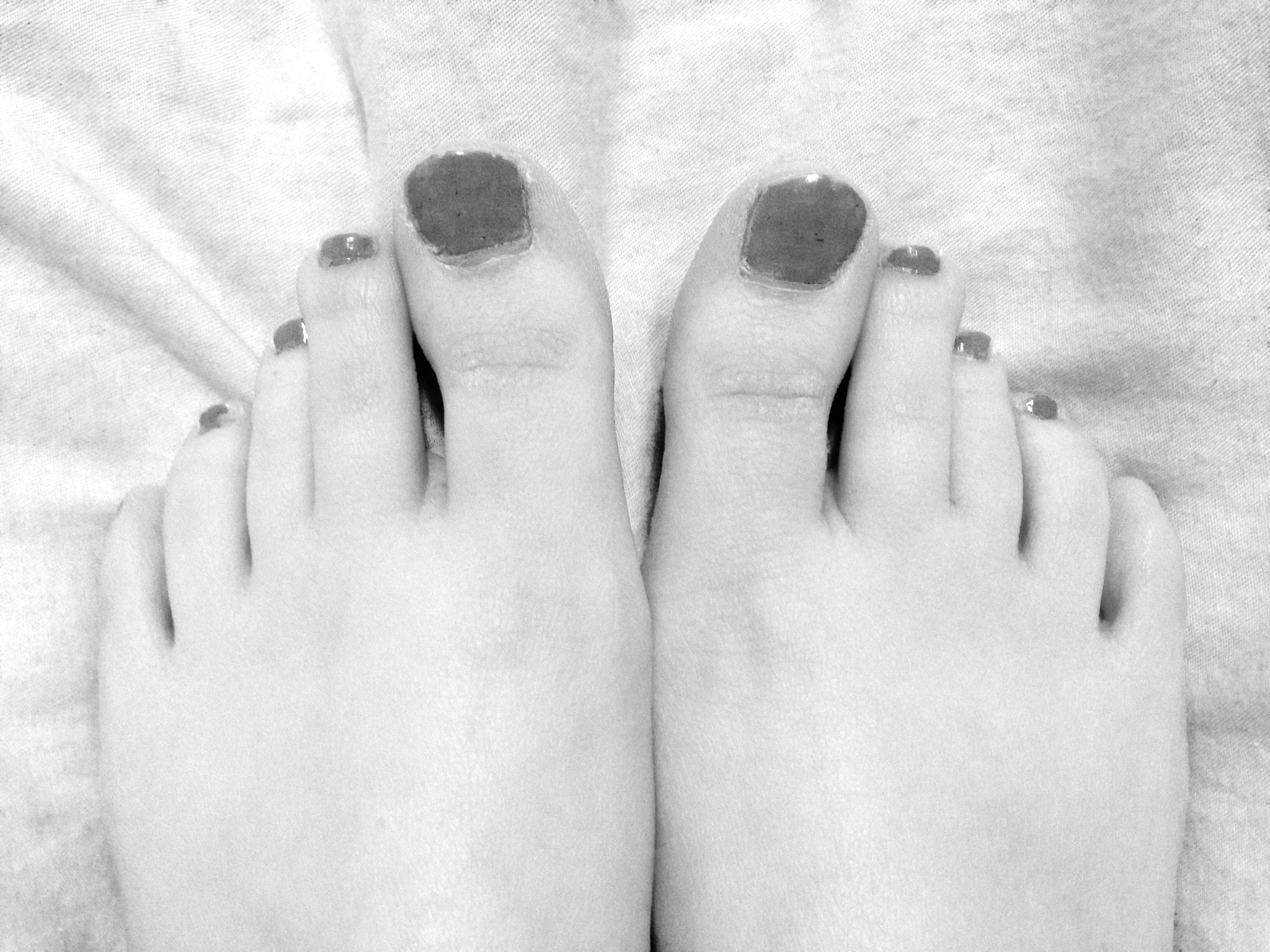
ToesI first noticed it late one December evening.  The little girl I was babysitting for had fallen asleep during her bedtime story and I sat next to her, legs outstretched on the bed, trying to devise a way to exit without making any noise.  Staring at my feet I realized that, although I could feel my legs, I wasn’t feeling my toes.  I moved them back and forth against one another, and the movement was there but I lacked the sensation that had been so obvious up until this point; I normally had extremely ticklish feet.

After going home and running my feet under hot water, doing various stretches, and attempting to tickle my toes with my fingernails, I conceded that at some point I’d have to get this checked out.  Although my doctor tried different means of treating my unfeeling toes, as the weeks passed the only change was more uncomfortable tingling in my feet.

I am still engaged in outward means of bringing my feet back to normal, but after a few months the true message my feet were trying to send to me became too clear to ignore.  I am addicted to numbing.  And after so much work trying to numb myself, my body took the hint and complied, “if numbness is what you want, numbness is what you will get.”

The desire to numb yourself of emotions and pain manifests itself differently in those trying to escape that which they fear.  Some numb themselves through shopping, others use food, entertainment, alcohol, drama, etc.  The means with which we numb ourselves is a personal preference.  What we try to numb ourselves from can be categorized as pain.  What is painful to each of us, and what we fear, is also custom made according to the individual.  But it all results in the attempt to use external things to numb inner discomfort.

So how can we possibly let go of that which numbs us, when we would do anything to not experience the pain that we are trying to avoid?  For me the answer came in the form of numb feet.  Having these cold tingly feet have made me realize how glorious my highly sensitive, ticklish feet were, as well as how powerfully thoughts and intentions manifest into form whether we want them to or not.  The numbness, although an attempt to escape pain, has turned out to be painful.  My body is letting me know that its harmonious functioning is dependent upon my ability to accept and feel that which I experience.

While some pain seems so overpowering that it may destroy you, in reality your consciousness is vast enough to encompass any experience it encounters.  Not only can your witnessing self withstand the discomfort, but allowing yourself to fully feel it as it arises keeps you healthy.  When pain is fully felt, it moves through you.  When it is numbed, it lies dormant within, containing the power to disrupt every aspect of your life.

Now when I feel discomfort, fear, or pain I say to myself, “I allow myself to feel this right now.”  Although in just the past week my tingly feet have had improved warmth and sensation, one of the medical tests the doctor still has to perform will involve needles and will undoubtedly be painful.  This I am afraid of.  So I allow both my fear of the situation, and the pain of the experience as well. Because the ability to feel is not only a sign of life, but is itself life sustaining.

Standard
You

How To Be Alone

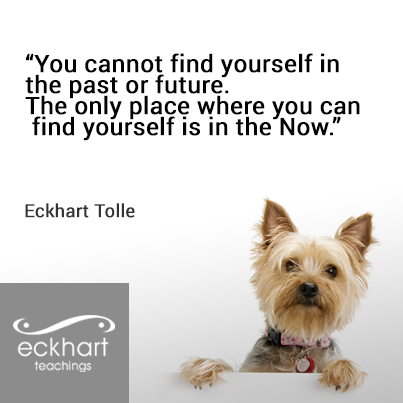
By Eckhart TolleThe following video is not just beautiful and inspirational.  It also speaks to the heart of the human experience and the lesson we must all learn at some point in our lives, at the latest when we are about to transition from this world.  That lesson is how to be alone.  Whether you are physically alone now or not, you are the only constant in the equation of your life, all other variables change.  Now is the time to discover that constant self, and now is in fact the only place where who you are can be found.

Standard